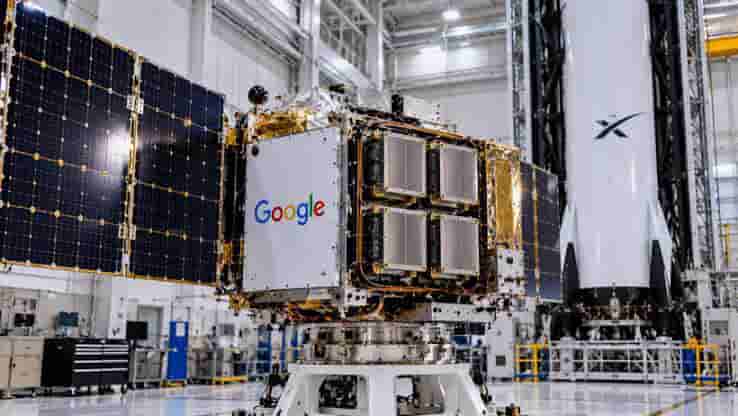
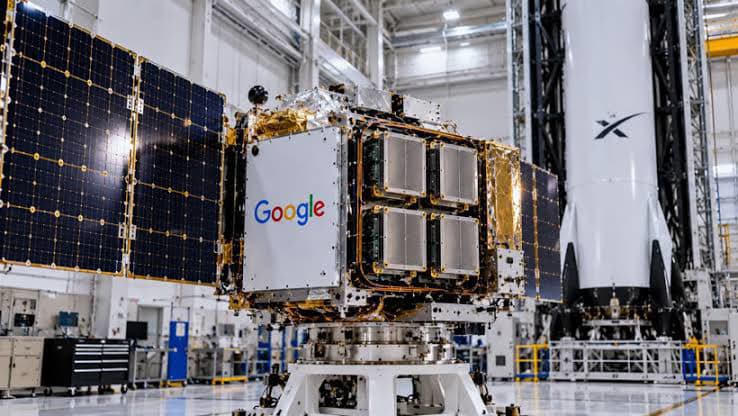
Google has run an artificial intelligence model on an orbiting satellite for the first time. Google CEO Sundar Pichai said the first prototype of the Suncatcher project, which aims to create data centers in space, responded to a command from Earth with a haiku. Pichai called the event a “Hello, world” moment for the project.
Engineers sent a command to the satellite, activated its tensor processor and asked the onboard Gemma model to write a haiku about being in space. They received the response as the satellite passed over the Norwegian archipelago of Svalbard.

“Starlight feeds my core”
The poem reads: “Blue globe below,
Data streams in silent grace,
Starlight feeds my core.” In subsequent tests, engineers asked the model for humorous space-themed poems and telemetry from the onboard systems.
The satellite, built in partnership with Planet, was launched into orbit on October 1 from Vandenberg Space Force Base in California as part of the SpaceX Transporter-18 mission. It carries four Google Trillium-generation tensor processors.
Solar-powered data centers
Google ultimately plans to create satellite constellations equipped with tensor processors, powered by solar energy and connected by laser links. The company notes that the Sun emits roughly 100 trillion times more energy than all of humanity generates as electricity, while satellites in sun-synchronous orbits can receive sunlight almost continuously.
The prototype is testing whether the processors can withstand launch, radiation and the challenge of dissipating heat in a vacuum; for now, they operate only in short sessions. In 2027, Google and Planet plan to launch two more satellites to test high-speed laser communication between them.