- BIST10011,722-2.89%
- USD49.42+0.06%
- EUR55.41+0.20%
- GOLD4,196.40+0.63%
- INTEREST37.00%-1.00
- BITCOIN81,556-0.70%
- October 16, 202613°
- BIST10011,722-2.89%
- USD49.42+0.06%
- EUR55.41+0.20%
- GOLD4,196.40+0.63%
- INTEREST37.00%-1.00
- BITCOIN81,556-0.70%
- October 16, 202613°



South Korean President Lee Jae-myung: Türkiye is a strategic partner for Korea
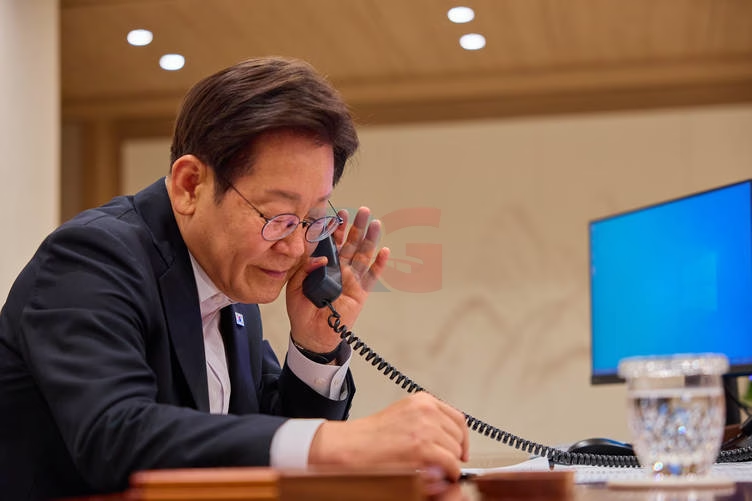
Ahead of his state visit to Türkiye, South Korean President Lee Jae-myung said his country will continue to value and strengthen its strategic partnership with "brotherly Türkiye," adding: "Türkiye is a strategic partner for Korea and an important hub in the Eurasia region."
Lee Jae-myung, who will pay a state visit to Türkiye at the invitation of President Recep Tayyip Erdoğan, answered questions from an Anadolu Agency correspondent in writing ahead of the trip.
Noting that Turkish and Korean soldiers fought shoulder to shoulder during the Korean War, Lee described the two nations as "brotherly countries bound by blood."
Lee underlined that his country will continue to value and strengthen its strategic partnership with "brotherly Türkiye," noting that Türkiye holds a unique strategic position connecting Europe, the Middle East, Eurasia and Africa.
"For Korea, Türkiye is a strategic partner with which we cooperate on innovation, investment and competition on a global scale," Lee said, adding that the two countries' strengths complement each other perfectly and that Türkiye has reached a position of global leadership in unmanned aerial systems.
Assessing his country's relations with North Korea, Lee said they want to move beyond hostility and conflict on the Korean Peninsula and open a new era of peaceful coexistence and shared prosperity: "Reunification remains our ultimate goal. Right now, relations on the Korean Peninsula face significant challenges. All channels of communication are frozen and trust has been damaged. For this reason, re-establishing dialogue is one of my top priorities. We are ready to engage in dialogue with North Korea at any time and through any channel, and the door to dialogue will remain open."
The details of the interview are as follows:
Türkiye and the Republic of Korea share deep historical ties often described as "a relationship forged in blood." Mr. President, which areas do you believe hold the greatest potential to further deepen this special partnership today?
Korea and Türkiye are brotherly countries bound by blood, having fought shoulder to shoulder to defend freedom and democracy. In 1950, even before establishing diplomatic relations with Korea, Türkiye sent more than 20,000 soldiers to fight in the Korean War. The memory of this sacrifice and solidarity created an environment of deep trust and friendship between the two countries and laid a solid foundation for mutually beneficial cooperation and development across a wide range of fields such as politics, economy and culture.
In practical terms, too, the industrial structures of the two countries naturally complement one another, forming a seamless supply chain spanning technology, production and sales. Korea is competitive in advanced technologies and precision manufacturing, while Türkiye has a robust production base and excellent market connections.
In the defense industry, for example, bilateral cooperation is quite vibrant and includes a series of projects involving joint production, technological cooperation and personnel training exchanges. A typical example of our strong defense partnership is the Altay Main Battle Tank production program. As both Korea and Türkiye advance toward becoming leading defense powers, I hope we can continue to expand cooperation in this area with mutual trust.
Building on the cooperation experience we have accumulated so far, we aim to broaden the scope of our cooperation to include future-oriented industries such as nuclear energy, bio-health, digital transformation, new and renewable energy, and artificial intelligence.
In the nuclear energy sector, talks are ongoing regarding the participation of Korean companies in Türkiye's Sinop Nuclear Power Plant project. With Korea's world-class nuclear technology and operational safety capabilities, I hope we can make a significant contribution to the development of Türkiye's nuclear energy.
We also see meaningful cooperation in the bio-health sector. Korea's SK Plasma is taking part in Türkiye's initiative to achieve self-sufficiency in blood products, and I hope this will further accelerate bilateral cooperation in the bio-manufacturing sector.
In the period ahead, Korea will continue to value and strengthen its strategic partnership with Türkiye, a brotherly country bound by blood. I look forward to both countries working together to build a prosperous future and contributing to the stability of the region and the international community.
"Türkiye is an indispensable partner for Korean companies"
Korean companies operate actively in Türkiye across various sectors such as automotive, construction, energy and electronics. Türkiye in particular is gaining increasing importance as a strategic production and investment hub connecting Asia, Europe, the Caucasus and Africa. In this context, do Korean companies plan to expand their investments in Türkiye?
Türkiye has a unique strategic position connecting Europe, the Middle East, Eurasia and Africa. With its strong industrial base, skilled workforce and broad network of trade agreements, Türkiye has become an indispensable partner for Korean companies and an increasingly important hub in global supply chains.
Korean companies have already made significant contributions to the Turkish economy in fields such as automotive, electronics, construction and materials. Companies such as Hyundai, Samsung, POSCO and Hyosung have strengthened exports and created jobs through direct investments amounting to $4.6 billion.
These investments have translated into concrete results across a wide range of sectors, demonstrating that our cooperation delivers real and shared benefits.
Building on this success, Korean companies now aim to deepen their presence in high-value sectors. These include areas such as electric vehicles, defense technologies and bio-health, where Korea's advanced capabilities and Türkiye's growing industrial ecosystem can create strong synergy. For example, Hyundai's decision to begin producing fully electric vehicles in Türkiye in 2026 will further connect our supply chains to Europe and support the transition to clean mobility on a global scale.
Similarly, cooperation in medical technologies and pharmaceuticals is opening new doors. Projects such as the plasma-derived medicine initiative show how the two countries can work together to strengthen their health security.
For Korea, Türkiye is not merely a production site. For Korea, Türkiye is a strategic partner that will help us innovate, invest and enhance our competitiveness on a global scale. I look forward to our private sectors continuing to expand cooperation in emerging industries that will shape the future.
"Türkiye has reached a position of global leadership in unmanned aerial systems"
In recent years, cooperation between Türkiye and Korea in the defense industry and advanced technologies has intensified. The most important example of this is the Altay Main Battle Tank engine project. In this context, are there any new joint defense projects or strategic agreements currently under discussion? Could you provide details about the scope of defense cooperation between the two countries?
The launch of Türkiye's first mass-produced Altay Main Battle Tank, equipped with a Korean engine, is a powerful example of what our two countries can achieve together. It reflects the deep trust and high-tech capacity that Türkiye and Korea bring to the defense sector.
Our strengths complement each other perfectly. Türkiye has reached a position of global leadership in unmanned aerial systems. Korea, meanwhile, excels in advanced platforms such as tanks, artillery and naval vessels. This creates significant cooperation potential that brings together the advantages of both countries.
Looking ahead, I believe we can expand our partnership with next-generation defense technologies. We can achieve this by integrating unmanned systems with conventional platforms, advancing mobility and protection technologies, and exploring new areas where our industries can innovate together.
As President, I am committed to supporting a forward-looking defense partnership between Korea and Türkiye that strengthens our security, advances our technological capabilities and contributes to stability beyond our two countries.
"We have taken a series of steps to make travel to Korea easier for Turkish citizens"
Due to the COVID-19 pandemic, some Turkish citizens find Korea's Electronic Travel Authorization (K-ETA) system inconvenient. Given that K-ETA is not mandatory for certain countries, is there a plan to exempt Türkiye from this requirement?
Korea attaches great importance to strengthening people-to-people ties with Türkiye, and we are aware that some Turkish travelers find certain aspects of the K-ETA system inconvenient. For this reason, our government has taken a series of steps to make travel to Korea easier and more user-friendly for Turkish citizens.
In response, we have simplified the application process through group applications, expanded language support to include Turkish, and extended the validity period of authorizations to three years. In addition, children under 17 and travelers over 65 are exempt from the K-ETA requirement.
K-ETA applies to all citizens of visa-waiver countries and serves an important purpose in ensuring safe and efficient entry procedures. While Korea has temporarily lifted the K-ETA requirement for a limited number of countries, these exemptions are scheduled to end next year, and there is no immediate plan to extend them.
That said, Türkiye has long been a friendly and reliable partner for Korea, and our cooperation continues to grow in many areas, from culture and tourism to trade, investment and advanced industry. As our relations expand, we fully understand the importance of facilitating travel.
Supported by easier interactions between our peoples, I am confident that the close friendship between our two countries will continue to grow.
"As of last year, bilateral trade has grown more than 1.5-fold compared to 2013"
What measures do you think should be taken to improve the trade balance between Türkiye and Korea?
Since the Korea-Türkiye Free Trade Agreement entered into force in 2013, our bilateral trade has grown significantly. As of last year, bilateral trade has increased more than 1.5-fold compared to 2013.
This shows that the agreement has provided a strong foundation for expanding economic cooperation between the two countries. At the same time, we fully understand Türkiye's concerns about the ongoing trade imbalance.
It is important to address this issue in a broader context. Much of the growth in Korea's exports to Türkiye has been driven by capital goods and intermediate inputs that support Türkiye's manufacturing and industrial development. As Türkiye has expanded its own production and export capacity, demand for these goods has naturally increased. In this sense, our trade structure also reflects Türkiye's ongoing industrialization and growing global competitiveness.
Korean companies have complemented this by investing more than $4 billion in Türkiye, creating jobs, transferring technology and helping strengthen key sectors such as automotive, electronics and materials. When trade and investment are considered together, our economic relations are far more balanced and mutually beneficial than simple trade statistics suggest.
Nevertheless, we are aware of the importance of moving toward a fair and sustainable trade structure for both sides. Some sectors, such as agriculture, involve sensitive domestic issues for Korea, and opening the market quickly is difficult. But this does not mean progress is impossible. We are exploring practical ways to expand the presence of high-quality Turkish products in the Korean market, including trade delegations, promotional events and greater participation in fairs and exhibitions.
Ultimately, what matters is not the balance of short-term figures, but whether our economic cooperation strengthens both countries' industries and prepares us for future growth. Türkiye is a strategic partner for Korea and an important hub in the Eurasia region. My government is determined to develop our economic relations in a more balanced, forward-looking and mutually beneficial direction.
"I see the greatest potential (for cooperation) in the construction and infrastructure sectors"
It is frequently mentioned that Turkish and Korean companies could carry out joint projects in third countries, particularly in the Middle East, Africa and Central Asia. Given the significant opportunities in the energy and infrastructure sectors, can we expect companies from the two countries to undertake joint investments in these regions in the near future?
The Republic of Korea and Türkiye have achieved significant results together through close cooperation. By combining the strengths of the two countries and using the experience and capabilities we have gained through cooperation, I believe we can create great synergy in third-country markets as well.
I see the greatest potential in the construction and infrastructure sectors. Türkiye's construction sector is recognized worldwide. Among the greatest strengths of Turkish companies are their rich field experience, exceptional construction capabilities and extensive networks spanning the Middle East, Africa and Central Asia.
Following the devastating earthquake of 2023, we once again witnessed Türkiye's extraordinary resilience in rapidly implementing large-scale reconstruction projects.
Korean companies can also bring their own strengths to this area. Korea is globally competitive in advanced engineering technologies, systematic project planning and quality management, as well as project finance (PF) and other capital mobilization capabilities.
By combining the strengths and competitive advantages of both countries to form "a single team," we can achieve the most ideal partnership.
This kind of cooperation has already been successfully proven on Turkish soil. The 1915 Çanakkale Bridge, the world's longest suspension bridge, along with the Eurasia Tunnel and the Yavuz Sultan Selim Bridge, stand out as magnificent achievements that demonstrate the combination of Korean technology and Türkiye's vision.
Using their complementary strengths and mutual trust, companies from the two countries can jointly capture third-country markets such as the Middle East, Africa and Central Asia, and gain a significant competitive advantage in winning contracts.
I also believe that the two countries can become the most effective partners in complex, large-scale infrastructure projects such as reconstruction efforts in Ukraine and Syria. This would be more than just a commercial success; it would be an exemplary model of cooperation contributing to sustainable development and peace in these regions.
The two countries (Türkiye and Korea) should work together to explore institutional and financial support measures that would facilitate such joint ventures in third countries and to identify concrete cooperation models.
"Although cooperation between the two countries in the nuclear sector is still in its early stages, the potential is enormous"
It is reported that Türkiye is in talks with Korean companies regarding its second nuclear power plant project, which would also include next-generation nuclear technologies such as small modular reactors (SMRs). Could you elaborate on what kind of cooperation Korea envisions in this area and your specific goals for cooperation with Türkiye in the nuclear energy sector?
Türkiye is evaluating various options for the construction of new nuclear power plants, and we know it has been in talks with its Turkish counterparts about possible cooperation with Korean companies.
Korea has a strong track record in this field over the past 20 years, including the successful completion of the Barakah Nuclear Power Plant in the United Arab Emirates and its participation in new projects in Europe. This experience demonstrates that Korea can be a reliable partner capable of carrying out complex projects safely and efficiently.
If Korean companies ultimately participate in Türkiye's nuclear power plant projects, they will serve as the most suitable partner by ensuring that these initiatives proceed "on time and on budget." Cooperation between the two countries in the nuclear sector can extend to a wide range of areas, including professional training and infrastructure building. Korea's approach focuses not only on building power plants but also on helping partner countries strengthen their overall nuclear ecosystems.
Korea is also developing next-generation technologies such as small modular reactors. Our i-SMR design is progressing toward the standard approval process and is expected to be ready for commercialization in the mid-2030s. As Türkiye evaluates its own path to adopting SMR technologies, we are ready to share information and explore future cooperation opportunities once Türkiye's plans take clear shape.
Although cooperation between the two countries in the nuclear sector is still in its early stages, the potential is enormous. Our government will continue to support constructive talks between our companies and Türkiye's energy authorities, and we look forward to expanding our partnership in a way that strengthens Türkiye's energy security and promotes sustainable development.
"We are ready to engage in dialogue with North Korea at any time and through any channel"
Lasting peace on the Korean Peninsula is crucial for regional stability. Could you share your concrete plans regarding this issue during your term? Also, is the idea of a "unified Korea" currently seen as a significant goal by the government and the public, or has it become more of a symbolic concept? Finally, do you have concrete plans or a direction you will follow to resume dialogue with North Korea?
The division of the Korean Peninsula has shaped the lives of our people for more than 70 years, and the pain of this history still weighs heavily on us. Achieving lasting peace is vital not only for Korea but for the stability of all of Northeast Asia.
My government's vision is clear: we want to move beyond hostility and conflict on the Korean Peninsula and open a new era of peaceful coexistence and shared prosperity. To this end, we are pursuing a comprehensive effort we call the "E.N.D. Initiative," aimed at advancing Exchange, Normalization and Denuclearization. To achieve sustainable peace, these three elements must move forward together.
Reunification remains our ultimate goal. This is not just an ideal but also a duty enshrined in the Korean Constitution. However, our government is not pursuing a path of unilateral unification; instead, we aim for gradual and phased reunification through peaceful coexistence and mutual development, in line with the democratic will of all Koreans on the Peninsula.
Right now, relations on the Korean Peninsula face significant challenges. All channels of communication are frozen and trust has been damaged. For this reason, re-establishing dialogue is one of my top priorities. We are ready to engage in dialogue with North Korea at any time and through any channel, and the door to dialogue will remain open.
We are also working closely with the United States, our indispensable partner for peace. The history of past U.S.–North Korea relations, including the summit meetings between U.S. President Donald Trump and North Korean leader Kim Jong-un, offers useful lessons and a foundation to build upon. President Trump and I are working closely on how to create the right environment for the resumption of dialogue, and Korea is ready to play a constructive and facilitating role when needed. In this context, I asked President Trump to be a "peace envoy" and offered my support as a "peace pioneer."
I do not believe peace is unattainable. With the determination and cooperation of all parties, we can rebuild trust, restart communication and take meaningful steps toward a stable, peaceful and ultimately unified Korean Peninsula. My administration will continue to work tirelessly to achieve this goal.
"I am determined to work in close cooperation with President Trump to ensure peace on the Korean Peninsula"
As North Korea has recently intensified its nuclear development program, there are growing public calls for South Korea to respond by acquiring its own nuclear weapons. Does South Korea plan to develop its own nuclear weapons?
During my visit to the United States in August, I delivered a speech at the Center for Strategic and International Studies on August 26. In that speech, I emphasized that I am determined to work in close cooperation with President Trump to resolve the North Korean nuclear issue and ensure peace on the Korean Peninsula. I also stressed that obligations under the Treaty on the Non-Proliferation of Nuclear Weapons (NPT) must be fully met on the Korean Peninsula, and that South Korea will maintain its commitment to denuclearization while adhering to the NPT regime.
For this reason, I would like to assure you that the South Korean government consistently supports the principles of preventing the proliferation of nuclear weapons and the peaceful use of nuclear energy under the NPT regime.
While the threat posed by North Korea's nuclear and missile programs persists, our government continues to regard the safety of the people as its top priority. To this end, we are further strengthening the South Korea–U.S. extended deterrence and continuously developing our own three-axis defense system to enhance our capacity to effectively deter and respond to any provocation.
"We must also manage our relations with our neighbor China in a balanced manner"
The rivalry between China and the United States is intensifying, and the clash between these two powers directly affects the Korean Peninsula. I would like to ask what kind of diplomatic balance Korea seeks between these two countries and what strategic direction it has set in this regard.
As the global situation changes rapidly, rather than seeking a diplomatic balance between the United States and China, we aim to respond to various urgent issues by focusing on South Korea's national interests, assessing the latest developments in competition, cooperation and challenges with an agile and multifaceted understanding.
While continuing to solidify the South Korea–U.S. alliance, the cornerstone of our foreign policy, we must also manage our relations with our neighbor China in a balanced manner. The reality is that while the United States is in competition and conflict with China, it also works in cooperation and coordination with China. In this context, rather than mutually exclusive approaches, I hope we can continue to strengthen the South Korea–U.S. alliance and advance South Korea–China relations harmoniously.
Long-standing economic cooperation with China has contributed significantly to our economic growth. China remains our largest trading partner and an indispensable partner for ensuring stable supply chains. However, unlike in the past, China's industrial competitiveness and advances in cutting-edge technology have caused a shift in the relationship between the two economies, from vertical complementarity toward horizontal competition. Therefore, from now on, while striving to enhance our industrial competitiveness, we must also lead the way in developing new growth engines that can foster horizontal cooperation with China.
We are expanding our economic cooperation with the United States to include various fields such as shipbuilding, bio-health and artificial intelligence. This will help enhance the competitiveness of our industries and move our economy forward. But it also brings a challenge: we must ensure that our large-scale investments in the United States do not lead to a hollowing-out of our domestic industries.
In terms of security, I believe that the emergence of a conflict situation such as an arms race in Northeast Asia would be undesirable. To counter North Korea's nuclear and missile threats, we aim to transform the South Korea–U.S. alliance into a comprehensive, forward-looking strategic alliance while also maintaining and developing our friendly relations with China. In this way, we can serve as a "bridge" to reduce tensions in Northeast Asia and promote shared prosperity. Moreover, I believe we can contribute to global stability and prosperity.
"Demand for K-beauty products in Türkiye continues to grow"
In recent years, South Korea has been actively present in various cultural and technological fields, including K-Pop, film and related technologies, gaining global influence through its soft power. I would like to ask how Korea's cultural influence benefits its foreign policy and how the Korean government uses this in its diplomatic strategies.
It is very gratifying and encouraging that Korean culture, technology and other forms of soft power are winning people's hearts around the world. I am aware that demand for K-beauty products in Türkiye continues to grow, and that K-content, including K-pop and K-dramas, has gained great popularity, especially among the younger generation.
I would like to highlight the alignment between the messages conveyed by so-called K-content and the goals of our foreign policy and, more broadly, of South Korea.
These goals include freedom, innovation, dynamism and diversity. The recently globally popular animated film K-Pop Demon Hunters exemplifies the power of change and inclusiveness that we pursue. I believe K-content embodies these values, which we must all strive for together. Expressed through diverse forms and stories, these values resonate globally and receive positive responses.
At the G20 Summit, I presented the world with a vision of future growth under the themes of "Inclusive and Sustainable Growth That Leaves No One Behind," "A Resilient World" and "A Fair Future for All." I expressed my commitment to restoring multilateralism and contributing to the prosperity of the international community.
This vision also reflects the values embedded in K-content. Just as K-content attracts interest and respect around the world, I hope that Korea's diplomatic vision will also be recognized by and resonate with broader audiences.
Featured Listings
Sponsored
Similar Interviews


TEKNOFEST Chairman Selçuk Bayraktar in Şanlıurfa: record attendance, Kızılelma and reverse brain drain
Журналисты на TEKNOFEST «Юго-Восток», Шанлыурфа
- 10/5/2026


Vice President Cevdet Yılmaz to CNN Türk: the Mecca pact, KAAN, Terror-Free Türkiye and EU visa liberalisation
CNN Türk
- 9/30/2026


Energy Minister Bayraktar to TRT Haber: Kirkuk, Sakarya gas, Gabar, Akkuyu and Hormuz
TRT Haber
- 9/30/2026
Featured News


Job Listings
Stay Updated with RuskiGazeta
Subscribe to be informed about special news, developments and announcements. We will keep you informed.
By signing up, you agree to our Privacy Policy











