- BIST10011,722-2.89%
- USD49.42+0.06%
- EUR55.41+0.20%
- GOLD4,183.30+0.32%
- INTEREST37.00%-1.00
- BITCOIN81,328-0.98%
- October 16, 202612°
- BIST10011,722-2.89%
- USD49.42+0.06%
- EUR55.41+0.20%
- GOLD4,183.30+0.32%
- INTEREST37.00%-1.00
- BITCOIN81,328-0.98%
- October 16, 202612°




Declining population, rising pressure: What does the closure of Turkish schools in Western Thrace mean?
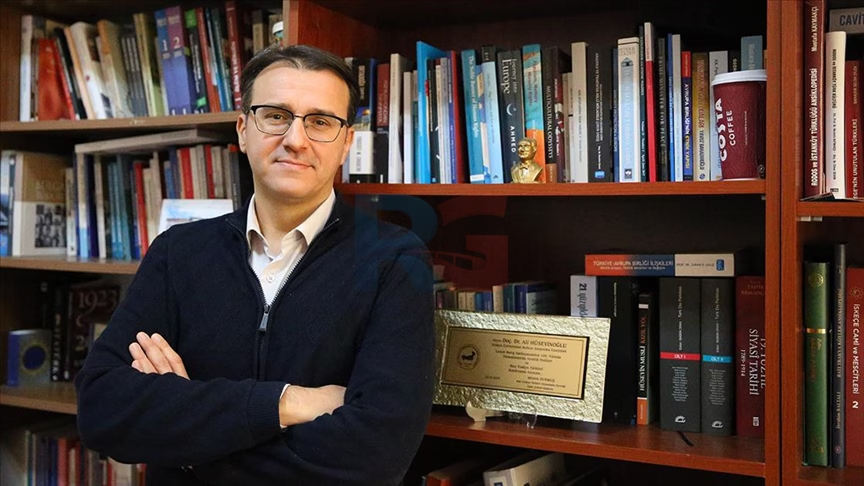
Assoc. Prof. Ali Hüseyinoğlu of Trakya University's Balkan Research Institute warns that the rapid decline of Turkish minority primary schools in Western Thrace amounts to serious violations of the right to education and of the Treaty of Lausanne.
Question: It is observed that Greece's Ministry of Education is closing Turkish schools in the provinces of Eastern Macedonia and Thrace. What is the latest situation regarding the number of schools and the closure rates?
Hüseyinoğlu: First of all, I would like to say this: In Greece, schools with fewer than a certain number of students are closed. If a school falls below 9 students, then — with some exceptional cases aside — it is closed, wherever in Greece it may be. The closure of Turkish schools can in fact be interpreted as part of a practice that exists across the entire country. But here we must underline that the special and autonomous status of minority primary schools has once again been disregarded by the official authorities.
In recent days there have been reports that 3 more Turkish minority primary schools in Western Thrace have been closed. This is true. In line with the decision taken by Greece's Ministry of Education, Religious Affairs and Sports, 32 primary schools and kindergartens were closed in the province of Eastern Macedonia and Thrace (of which Western Thrace forms a part) in the 2025-2026 academic year. Three of these schools are minority primary schools belonging to the Turks of Western Thrace.
Of 305 schools a century ago, only 83 remain
Question: How has the number of Turkish primary schools changed over the years?
Hüseyinoğlu: The number of Turkish minority primary schools is very important. In the 1930s, there were a total of 305 Turkish minority primary schools in the provinces of Rhodope, Xanthi and Evros, which make up the Western Thrace region. In 1931, this number dropped to 304. By the 1950s, this figure fell to around 290, and in the 1970s to around 280. We see the biggest decline after the 1990s. In 1995 there were 231 schools. By the early 2000s this number fell to 220. From the early 2000s onward, except for some exceptional years, this figure has decreased further every year, falling to around 83 today.
Question: What is the main reason behind the closure of the schools?
Hüseyinoğlu: The most fundamental reason in this regard is that, starting in the 1950s and regardless of which government was in power, the Greek state has systematically and gradually intervened in various ways in minority education in Western Thrace. Over time, the number of Turkish-language lessons taught in these schools was reduced. In these bilingual schools, the quality of education in both Greek and Turkish was deliberately lowered. In the context of denying the ethnic Turkish identity, the word "Turkish" was removed from the schools' signboards. As a result, in line with many decisions taken by Greek governments regarding minority education, a negative image was created around Turkish minority primary schools and the quality of Turkish and Greek education provided in them. Faced with this, over time some Turkish minority parents in Western Thrace came to accept the perception that the Turkish minority primary school in their own village or neighborhood provided "lower-quality education." Thus, some Turkish parents — even when they had the means — chose Greek primary schools over Turkish ones for their children's basic education, due to this manufactured negative perception or for various personal and family reasons. In this way, many Turkish minority primary schools were closed on the grounds of a lack of students.
Question: Why is Greece targeting Turkish schools?
Hüseyinoğlu: The closure of the schools can in fact be interpreted as the result of a process. And this process began roughly 70 years ago. The systematic policies of pressure, intimidation and coercion applied to the Turks of Western Thrace, especially in the 1960s, 70s and 80s, were undoubtedly reflected in the field of education as well. We see that the perception that "poor education is provided in Turkish minority schools" has, over time, influenced the choices of some Turkish parents.
Turkish minority primary schools that are "temporarily" closed never reopen
Question: It is said that the schools are temporarily closed or that education in them is suspended. In your view, could the schools be reopened in the future?
Hüseyinoğlu: These schools are first closed temporarily for 3 or 4 years. For example, in the most recent official suspension decision, it is stated that some Turkish primary schools have been temporarily closed for 2 years. But a school closed temporarily for 3-4 years never reopens. Officially, it is stated that education in these schools has been temporarily suspended. But in reality, is there any minority primary school that was temporarily closed and later reopened? In fact, there were some requests in this regard, as in the cases of Musaköy and Hacımustafaköy. However, it was never seen that the competent authorities granted the necessary permissions and reopened the temporarily closed Turkish primary schools. The reopening of the schools in the future is in fact a possibility. But this will largely depend on potential demand from the minority and on the attitude of the competent authorities in this regard.
The negative perception about Turkish minority primary schools is not based on facts
Question: What is the level of education in Turkish schools?
Hüseyinoğlu: In fact, there are many people who graduated from Turkish primary schools and work both in Greece and in Türkiye. There are many doctors, lawyers, engineers, business people, teachers and academics who have reached certain positions in the society they live in. So we actually see members of the Turkish minority in various professions. However, I think this fact is not sufficiently taken into account within the Western Thrace Muslim Turkish minority community at the stage of choosing a primary school.
Despite this, we see that the perception that "inadequate education is provided" in Turkish minority primary schools is intensely accepted among some Turkish parents. The factual basis of this negative perception is seriously questionable. Nevertheless, some Turkish parents prefer Greek schools, and because they do not send their own children to Turkish schools, the total number of students in these schools decreases further day by day.
Question: Why are these schools important for the Turks of Western Thrace?
Hüseyinoğlu: Looking at it from the perspective of the Turks of Western Thrace, the existence of these schools is of vital importance for their centuries-old presence in the region. For the Turks of Western Thrace and for all other communities, a minority primary school means the present and future existence of the Turkish and Muslim identities that have continued in the region for centuries. In this context, these schools are very valuable for the Turks of Western Thrace, and receiving education in two languages here is very important. Because your level of education continues to seriously affect your place, status and acceptance in society.
Turkish minority primary schools form the backbone of Turkish-language education in Western Thrace
Question: What does the closure of Turkish primary schools in Western Thrace mean in terms of Turkish identity and Turkish-language learning?
Hüseyinoğlu: The closure of the schools is of great importance for the right to education of the Turkish minority in the region. As I mentioned before, these schools, which numbered over 300 in the 1930s, have today fallen to figures in the 80s.
Education is among the most fundamental elements of communal existence. Especially for minority communities, it serves as an important bridge that determines their position within the majority society of the country they live in. In this context, the closure of Turkish schools stands before us as one of the most important problems of the Turkish minority community.
The backbone of Turkish-language education in Western Thrace is undoubtedly formed by the Turkish primary schools that provide education in two languages (Turkish and Greek). In terms of preschool education, there are no Turkish kindergartens. Thus, from the 1920s to the present, Turkish minority primary schools are undoubtedly among the foremost institutions where the mother tongue Turkish, as well as Turkish culture, customs and traditions, are taught to children at an early age. But with these schools being closed at such a rate every year, in the near future significant problems may arise regarding the transmission of both the mother tongue Turkish and Turkish culture to future generations.
The principle of "autonomous education" envisaged in the Treaty of Lausanne has, over time, been violated by Greece
Question: How does the closure of Turkish primary schools constitute a violation of the education-related articles of the Treaty of Lausanne?
Hüseyinoğlu: The closure of these schools is contrary to the education-related articles of the Treaty of Lausanne. Articles 40 and 41 of Lausanne contain provisions on minority education. The 1923 Treaty of Lausanne is of an international nature. Thus, minority education in Western Thrace and many individual and collective rights and freedoms related to the Turkish minority are under international protection. In fact, when we look at Lausanne, these schools should have a special and autonomous structure. However, as a result of the systematic interventions carried out since the 1950s, we see that this special and autonomous structure has today been almost lost. For example, since the 1970s, Greece removed the word "Turkish" from the signboards of Turkish schools. These schools are still officially referred to today as "Muslim" or "Minority" schools. As a result of many laws and ministerial decrees issued regarding these schools, whereas in the past members of the minority had a say in many matters related to education, today they have the right to a say in almost very few matters. In terms of education and many other matters concerning the rights of the Turkish minority, we see that the rights envisaged in the Treaty of Lausanne are still not fully implemented.
Declining population and economy-driven migration play a role in the closure of Turkish primary schools in Western Thrace
Question: Apart from education, what kinds of difficulties do the Turks of Western Thrace face?
Hüseyinoğlu: As an academic who wrote his doctoral thesis on the educational rights of the Turks of Western Thrace and who still conducts scholarly work on the rights and freedoms of the Turks of Western Thrace, I would like to state this: Among the most important problems of the Turks of Western Thrace, education undoubtedly comes first. But in recent years, I think the economy must also be added to the top of the list. In the past, education led the way. But now, after the economic crisis Greece experienced in 2010, the economy too has emerged as a very serious problem facing the Turks of Western Thrace.
Especially after the 2010 crisis, we see that some members of the Western Thrace Turkish minority temporarily left the region due to unemployment and migrated to various parts of Europe for work. Foremost among these countries are Germany, the Netherlands, Norway and the United Kingdom.
Question: Is migration driven by the economic crisis related to the closure of the schools?
Hüseyinoğlu: This kind of migration in fact, at a certain point, affects education as well. Sometimes only the father migrates. But a year or two later, the mother and children may also join him. From what I have observed over the past decade, some families who went as temporary workers can, after a certain period, bring their own families to join them. In addition, in recent years there has been a decline in the number of Turkish minority families with three or more children. This may cause the Muslim Turkish demographic in Western Thrace to decline even further over time. Time will tell whether the temporary migration will become permanent. But the phenomenon of migration in the Western Thrace Turkish community means that there will be fewer Turkish children in the region in the near future. In other words, another reason for the closure of Turkish schools is the phenomenon of migration. We see in particular that the number of Turkish children in rural villages has declined even further as a result of migration. But it should not be forgotten that the real reason stems from the fact that the special and autonomous status of minority education, as I expressed earlier, has been seriously damaged over the years.
Featured Listings
Sponsored
Similar Interviews


TEKNOFEST Chairman Selçuk Bayraktar in Şanlıurfa: record attendance, Kızılelma and reverse brain drain
Журналисты на TEKNOFEST «Юго-Восток», Шанлыурфа
- 10/5/2026


Vice President Cevdet Yılmaz to CNN Türk: the Mecca pact, KAAN, Terror-Free Türkiye and EU visa liberalisation
CNN Türk
- 9/30/2026


Energy Minister Bayraktar to TRT Haber: Kirkuk, Sakarya gas, Gabar, Akkuyu and Hormuz
TRT Haber
- 9/30/2026
Featured News


Job Listings
Stay Updated with RuskiGazeta
Subscribe to be informed about special news, developments and announcements. We will keep you informed.
By signing up, you agree to our Privacy Policy











