- BIST10011,722-2.89%
- USD49.42+0.06%
- EUR55.41+0.20%
- GOLD4,183.30+0.32%
- INTEREST37.00%-1.00
- BITCOIN81,328-0.98%
- October 16, 202612°
- BIST10011,722-2.89%
- USD49.42+0.06%
- EUR55.41+0.20%
- GOLD4,183.30+0.32%
- INTEREST37.00%-1.00
- BITCOIN81,328-0.98%
- October 16, 202612°



Energy Minister Bayraktar to TRT Haber: Kirkuk, Sakarya gas, Gabar, Akkuyu and Hormuz
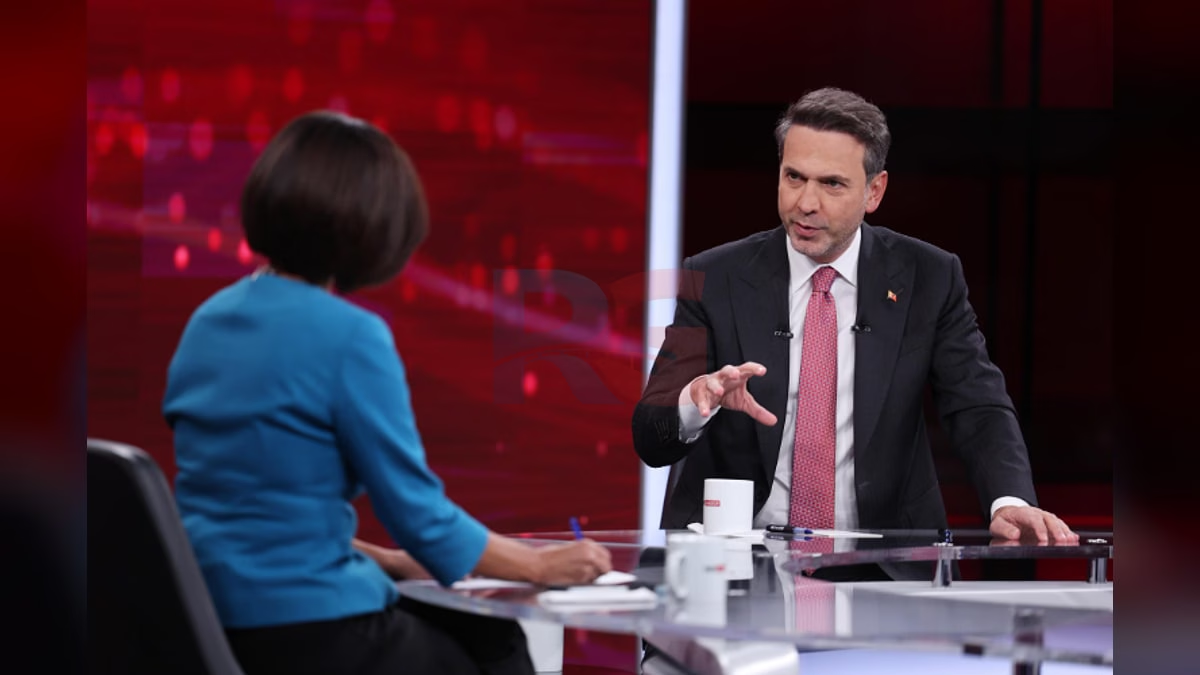
In an interview with TRT Haber on August 4, Energy and Natural Resources Minister Alparslan Bayraktar discussed Kirkuk oil and the Iraq–Türkiye pipeline, the latest on Sakarya gas and Gabar oil, deep-sea drilling off Somalia, security of supply in the face of the Hormuz crisis, energy projects for the TRNC, the goal of first power at Akkuyu, and offshore wind tenders.
Kirkuk oil and energy cooperation with Iraq
Turkish Petroleum has become a partner in the company operating oil fields in Kirkuk. What does this partnership mean?
Kirkuk is an issue we have been working on for about two and a half years. We are trying to turn Turkish Petroleum into a company that produces 1 million barrels a day, with part of that produced in Türkiye and part abroad. The Iraq and Kirkuk agreement is in fact part and a reflection of this. Kirkuk is a place where a British oil company has been producing oil for about 100 years. And now, 100 years later, we are in a sense becoming a partner in these oil fields in Kirkuk. We also have an American partner there. So it has a very large oil reserve in which Britain, the United States and Türkiye are partners. We are currently talking about an oil reserve of around 3 billion barrels. In today’s figures, that is an economic value of 250 billion dollars. There is potential for daily production to rise to 1.2 million barrels.
An agreement has been reached for a flow of 750,000 barrels a day through the Iraq–Türkiye Crude Oil Pipeline. Can the capacity be increased, and is extending it to Basra on the agenda?
There are many projects we are trying to develop with Iraq in energy. We are saying, ‘Let’s build an oil pipeline from Silopi, from Habur, all the way to Basra.’ The Hormuz crisis told everyone: ‘The world definitely needs alternative routes.’ Right now we can carry these 750,000 barrels through our existing lines. In fact, our existing lines can carry 1.5 million barrels. We are saying: ‘We can increase this volume to 2–2.5 million barrels and extend the pipeline to Basra. Through this route we can open to world markets part of Iraq’s production, as well as that of Kuwait and Gulf countries that say, “I want to use this line; I don’t want all my oil to pass through Hormuz, because it is unclear what may happen to us there.”’
What other areas of cooperation with Iraq are on the agenda?
Iraq currently has a very serious electricity problem. It has infrastructure problems. We have offered them short-, medium- and long-term solutions. We are currently exporting electricity, and the Prime Minister asked our President to increase the amount. So we are heading towards a period with projects in which our relations will improve further.
One of our topics is gas. Natural gas is one of the projects we are discussing, initially for Iraq’s own needs, since the gas-fired power plants in Iraq need gas to generate electricity. At first, perhaps, we are discussing exporting part of this to Iraq using Türkiye’s infrastructure and the natural gas in Türkiye. We are also discussing a major project to build a natural gas pipeline alongside the oil pipeline we plan to extend to Basra and the power transmission lines, so that in the future Qatari gas and gas produced in the Gulf could flow in reverse, through Iraq to Türkiye and through Türkiye to Europe. Of course, as an alternative route, Qatari gas could also reach Türkiye via Saudi Arabia, Jordan and Syria. In other words, all roads actually lead to Türkiye.
“The gas needs of 8 million homes in Türkiye will be met from our own field”
What stage has production at the Sakarya gas field reached?
The timeline for Phase 2 is clear. By the end of 2026 we will double our production from the Sakarya gas field to 20 million cubic metres. The natural gas needs of 8 million homes in Türkiye will be met from our own gas field. By 2028 this will rise to 16–17 million households, and daily production will have reached 40–45 million cubic metres.
This year is very important for us because we will produce offshore. Our floating production platform Osman Gazi will leave Filyos around the end of September and head to its location in the Sakarya gas field in the Black Sea, where it will serve for 20 years. There we will fix it to the seabed; the final work will be done and tests will be carried out, including a major gas flaring test. After that, inshallah, we will start production.
What is the latest at Gabar? How is the Terror-Free Türkiye process reflected in energy?
Production at Gabar is rising. Today we have reached 83,200 barrels. This is a new record. We have reached daily production of 83,200 barrels. We break a new record at Gabar every day. We are making new discoveries, so we continue to increase our production. Gabar, inshallah, will grow even further.
Gabar is a small slice of the potential Türkiye will unlock once it removes terrorism from its agenda. That region was cleared of terrorism, and after that we began to see results from our work there. Its social, economic and employment impact, and what it has brought to the region, is tremendous. It has turned into a major project that provides jobs for thousands of people, most of them the region’s own children from Şırnak.
From Somalia to Pakistan: exploration abroad
What is the status of the first deep-sea drilling off Somalia?
In Somalia we are going it alone; we are the operator. Our ship Çağrı Bey is drilling there now. In this offshore field with a water depth of 3,450 metres, we have reached around 4,000 metres. That means we are 500–600 metres below the seabed. Our drilling continues. This well could go as deep as 7,000 metres. Inshallah, we aim to get a good result from Somalia.
Since the start of the year you have signed agreements with the world’s major energy companies. Where do they stand?
At the beginning of the year we signed an agreement with Exxon. Then we signed agreements with Chevron, BP, Shell and Total. Now these cooperation agreements are turning into concrete projects. The BP agreement has turned into a concrete, clear, commercial project in Kirkuk. The others will gradually follow.
Which other fields abroad are you working on?
In the Black Sea, we acquired a 33 percent stake in a field in Bulgaria’s waters. We will explore for natural gas there.
In Africa we are working very intensively in Guinea-Bissau, Angola, Liberia and Libya. In Libya we have acquired two fields with foreign partners, one offshore and one onshore, but we are working on a much bigger project. Inshallah we will get a result there. Beyond that, in Central Asia there are fields we are interested in, in Kazakhstan and Azerbaijan. We had acquired fields in Iraq and Pakistan, and we are now actually starting work there. In Pakistan we are starting somewhat late; this war affected our operation there. Oruç Reis’s new assignment is Pakistan; it will go there. Soon we will launch a process concerning offshore fields in Bangladesh. So we are engaged in very intensive work.
“All of Türkiye’s natural gas storage facilities are full”
What strategy are you following to avoid being affected by crises like the one in Hormuz?
This is a very big economic crisis, and one where we do not know where it will stop. The Hormuz crisis began on February 28, and we are approaching half a year. There is incredible volatility in the markets; one day the oil price rises 6 percent, the next day it falls 4 percent.
But Türkiye set itself a fundamental strategy a long time ago: diversification. We strive to diversify our supplier countries and our routes. If we were still receiving our natural gas via the Western Line through Ukraine, we would certainly have faced a supply shock when the war began in 2022. Thanks to TurkStream, that did not happen; that line has now become Türkiye’s export route. We have also signed LNG agreements with partners ranging from the United States to Algeria and Nigeria.
We did this for ourselves, but thanks to this infrastructure many countries can now benefit. Iraq can take the oil it produces to world markets via Türkiye; natural gas from Azerbaijan goes to Syria via Türkiye. Cooperation with Türkiye can create an equation in which everyone wins.
How much energy is in storage in case of possible disruptions?
Our storage capacity in our natural gas infrastructure has now reached about 6.3–6.5 billion cubic metres. We can store enough natural gas in our own facilities to supply our homes for 45 days in the coldest part of winter. Our goal is to double this, raising our storage capacity to 12–13 billion cubic metres. Without waiting for winter, all of Türkiye’s natural gas storage facilities are currently full. We also monitor the storage of oil and oil products every day.
The TRNC, nuclear power and renewables
Which projects are you pursuing to solve the TRNC’s energy problem?
We have developed two projects to help solve the island’s energy problem. One is to build an electricity transmission line to the island via Türkiye, to bring electricity generated in Türkiye, especially from renewable sources, to the island and electrify it in this sense. In addition, there is the natural gas pipeline project; one of its goals is to generate electricity from the natural gas we will bring to the island and to meet all of the island’s electricity needs locally with a cleaner and more affordable fuel.
When will the Akkuyu Nuclear Power Plant produce its first electricity?
Work at Akkuyu, especially on the first reactor, is continuing at full speed. For the first reactor there is a testing process of nearly 2,000 tests; by its very nature, nuclear power is a process in which nuclear safety comes first. We are currently at around 15–20 percent of the tests. We aim to complete them and move to test production, that is, first power generation, by the end of the year.
We are doing all of this by prioritising safety. Construction is also continuing on the second, third and fourth reactors, but right now the entire effort of both the Russian side and ours is focused on achieving the goal Türkiye has pursued for 70 years: generating electricity from that first reactor.
Which countries are you talking to about the Sinop and Thrace nuclear projects? Could an agreement be signed this year?
The Sinop and Thrace plants are also among Türkiye’s most important goals. For the past few months we have had intensive contacts, especially with Canada and South Korea; the process with Canada has accelerated somewhat recently. In June, in Romania, we saw on site two operating nuclear reactors built with Canadian technology.
We are looking for the technology we can obtain on the terms most suitable for Türkiye: a project that brings technology transfer and know-how, develops our human resources and ensures localisation. At Akkuyu, for example, we have achieved localisation of more than 50 percent; of the roughly 20 billion dollars spent, 11 billion dollars stayed in Türkiye. Our goal is to sign before the end of this year. But one of the most important dimensions of nuclear power is financing; we are talking about foreign investments approaching 30 billion dollars. Once we resolve the financing side, we will sign these agreements.
What is the tender timetable for wind and solar investments?
Türkiye is hosting COP31, and in November a message will go out to the world from Antalya. Every year we bring 7,000–8,000 megawatts of new solar and wind capacity online.
We are becoming ready to commission the first floating solar plants in Türkiye. Offshore wind will be a first for Türkiye. In 2026 we are continuing the YEKA renewable energy zone projects that we announced we would hold every year. Before COP31 we will hold tenders for our onshore wind and onshore solar projects; we will tender around 2,400 megawatts of capacity. Our goal is to announce the offshore wind YEKA around September–October and hold the tender in the first quarter of 2027. I hope we will carry out our offshore YEKA tender in the first quarter of 2027.
“We are pursuing the goal of energy independence”
What is Türkiye’s goal in the new energy architecture?
We want to reduce our energy import dependence, which reaches 65–70 percent, initially to around 50 percent, perhaps a little lower. The world is rapidly electrifying and digitalising; artificial intelligence also consumes energy, and Türkiye’s competitiveness must be ensured here. The tension in the Gulf and the fragility there make our country stand out as a safer haven; we want our energy infrastructure to be so strong that investors can come to Türkiye with confidence.
We envisage a Türkiye with 8 to 10 million electric vehicles on the roads in 2035. That means Türkiye’s need for, and imports of, oil and diesel will fall accordingly. In the medium and long term, we are pursuing the goal of energy independence.
Featured Listings
Sponsored
Similar Interviews


President Erdoğan to Al Jazeera: the Mecca pact, Hormuz, Syria, Gaza and the F-35s
Al Jazeera Arabic
- 9/30/2026


President Erdoğan to Asharq Al-Awsat: the Mecca pact, Hormuz, Saudi Arabia, Lebanon and Syria
Гассан Шарбель (Asharq Al-Awsat)
- 9/29/2026


President Erdoğan to Newsweek: UN reform, Iran, the Mecca pact and Russia-Ukraine
Newsweek
- 9/29/2026
Featured News


Job Listings
Stay Updated with RuskiGazeta
Subscribe to be informed about special news, developments and announcements. We will keep you informed.
By signing up, you agree to our Privacy Policy











