- BIST10011,722-2.89%
- USD49.42+0.06%
- EUR55.41+0.20%
- GOLD4,196.40+0.63%
- INTEREST37.00%-1.00
- BITCOIN81,556-0.70%
- October 16, 202613°
- BIST10011,722-2.89%
- USD49.42+0.06%
- EUR55.41+0.20%
- GOLD4,196.40+0.63%
- INTEREST37.00%-1.00
- BITCOIN81,556-0.70%
- October 16, 202613°





Oleka Capital founder İlker Sözdinler: AI will make everyone faster, but it won't make everyone a better investor
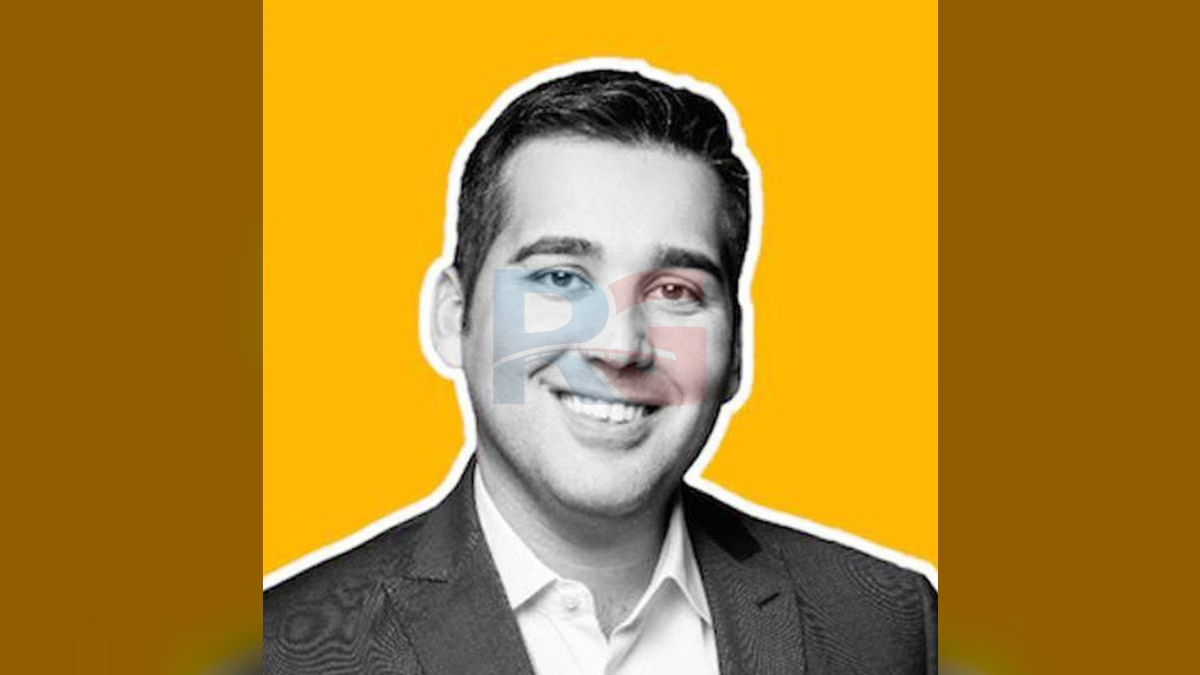
İlker Sözdinler, who founded United Payment, took it into international markets and saw it through an exit, is now the founder of Oleka Capital, working between London and Istanbul. Speaking to Fintechtime's September issue, Sözdinler discussed how fintech has changed, the signals he looks for in founders, Türkiye's growth-capital gap, how foreign investors see Türkiye and how artificial intelligence is changing the investment world.
This text is a question-and-answer summary compiled from the interview Fintechtime published on 2 September 2026.
The deepest change in fintech
Looking back on your journey from entrepreneur to investor, where do you see the deepest change in the fintech world?
He said fintech has gone from a sector that had to prove itself to a permanent part of the financial system. When he founded United Payment, obtaining a licence, finding a strong banking partner and reassuring customers were competitive advantages in themselves; today banks also see fintechs as business partners and distribution channels. Building products has become faster, he stressed, but building a lasting financial institution has become harder: great companies are created not by technology alone but by teams that can combine technology with trust, regulation and strong distribution.
Signals he looks for in founders
What makes you think "this person can build a big company"?
He listed four signals. First, intellectual honesty — being able to explain openly what is going well and what is not. Second, speed of learning and execution — changing direction when the right data arrives. Third, the ability to hire people better than oneself and give them room. Fourth, behaviour in a crisis: keeping the team and customers on side when cash runs short or regulation changes.
Is the problem capital or experience?
Is the main problem of Türkiye's ecosystem a lack of capital or an immature growth culture?
He said the two cannot be separated. The conversion rate from seed to Series A is around 5 percent in Türkiye versus about 19 percent in Europe, and local players quickly thin out in $5–10 million rounds. Life after Series A, he noted, is not just more money: it means international sales, senior executives, institutional reporting and entering new markets with the right partner. That is why Oleka was founded as a "growth partner"; what Türkiye needs, he said, is patient and operational capital.
The metrics that changed in the investment committee
After the era of "growth at any cost", which metrics came to the fore?
He said investors now look at the quality of growth as much as its speed: net revenue retention, churn, the payback period on customer acquisition cost, revenue concentration and revenue per employee. In fintech, he stressed, it is critical to separate transaction volume from real revenue — a large volume does not necessarily mean strong economics. The committee keeps coming back to three questions: Do customers really stay? Do unit economics improve as the company grows? Can management control its own destiny when access to capital gets harder?
Portfolio and investment thesis
What defines Oleka's investment thesis?
He said they look for proven product-market fit, a leading position or a defensible niche in the home market, a business model that can travel to other countries and a team able to execute internationally. He gave examples from the portfolio: Wamo, positioned in SME banking in Europe; Onlayer, which takes its financial-crime-fighting products to MENA and Asia; Zen Educate, which connects schools with teachers; and Tasklet, which builds the layer between AI models and companies' workflows. B2B AI applications, regtech, cybersecurity and cross-border financial infrastructure will come to the fore, he said, but the "AI" label alone is not an investment thesis.
Resilience: not scars, but the capacity to learn
Can the resilience you highlighted in Wamo's case be measured?
He said resilience cannot be written into a single cell, but its results can be measured. Wamo went through a severe test when its banking partner collapsed and accounts were frozen; the team kept its composure and carried on with a more robust infrastructure, and founder Yankı Önen put his personal wealth into the company. He added that he is wary of flawless growth charts: "What we look for is not scars, but the capacity to learn."
Türkiye through a foreign investor's eyes
As someone working between London and Istanbul, how do you see Türkiye's fintech capability from the outside?
He said Türkiye's capability is stronger than outsiders assume: an advanced banking infrastructure, fast and pragmatic engineers and a location between Europe, MENA and Central Asia are real advantages. But foreign investors do not pay a premium for good engineering alone; they expect international revenue, a repeatable sales model, strong governance and predictable reporting, while country and currency risk widen the valuation discount. The way to narrow that discount, he stressed, is not to tell the Türkiye story more loudly but to produce more evidence — foreign-currency revenue and successful international exits.
From unicorn to lasting global institution
Is turning a billion-dollar company from Türkiye into a lasting global institution harder than creating it?
He said it is definitely harder, and that success should be measured not by the number of unicorns but by the number of companies still leading their category ten years on. He called for a shift from the "hero founder" model to institutional leadership on the founders' side; patient growth capital able to provide follow-on funding on the investors' side; and, in the capital markets, more long-term allocation by domestic institutional investors to technology, easier employee stock options and deeper IPO channels.
AI and the maths of investing
How will artificial intelligence change investment decisions?
He said AI does not change the basic maths of investing, but the cost and speed of getting to it. At Oleka, agents are used for deal screening, market research, data-room review, financial analysis and reporting. As access to data gets cheaper, he said, the edge will shift to judgement, trust with founders and networks: "AI will make everyone faster, but it won't make everyone a better investor."
Fintech opportunities for the next decade
Which areas would you recommend to a young fintech entrepreneur?
He said the companies that survive the next five years will be those that own an indispensable workflow in the customer's financial life. He would not tell a young founder to "build the next consumer wallet"; instead he would point to AI-powered finance operations for SMEs, payment and treasury infrastructure for companies working across borders, financial-crime and identity-verification solutions, and embedded lending and insurance based on transaction data. The big fintech companies of the next decade, he said, will be those that most reliably solve the invisible but critical jobs of finance.
Photo: Oleka Capital
Featured Listings
Sponsored
Similar Interviews


President Erdoğan to Al Jazeera: the Mecca pact, Hormuz, Syria, Gaza and the F-35s
Al Jazeera Arabic
- 9/30/2026


President Erdoğan to Asharq Al-Awsat: the Mecca pact, Hormuz, Saudi Arabia, Lebanon and Syria
Гассан Шарбель (Asharq Al-Awsat)
- 9/29/2026


President Erdoğan to Newsweek: UN reform, Iran, the Mecca pact and Russia-Ukraine
Newsweek
- 9/29/2026
Featured News


Job Listings
Stay Updated with RuskiGazeta
Subscribe to be informed about special news, developments and announcements. We will keep you informed.
By signing up, you agree to our Privacy Policy











