Kazakhstan and Azerbaijan have commissioned the Trans-Caspian fiber-optic communications line, which is planned to strengthen digital connectivity between Asia and Europe. Kazakhstan President Kassym-Jomart Tokayev and Azerbaijan President Ilham Aliyev attended the online opening ceremony.
Announced on Thursday, Oct. 15, the project connects Kazakhstan's city of Aktau with Azerbaijan's city of Sumgait. The 380-kilometer line was built by Kazakhstan-based Kazakhtelecom and Azerbaijan-based AzerTelecom as part of the Digital Silk Way initiative.
Digital connection to Europe via the Caspian
The Trans-Caspian line has a capacity of more than 400 terabits per second. The project is planned to become part of an international data transmission route extending from China and Central Asian countries to Europe via the Caspian Sea, Azerbaijan and other transit countries.
The line is expected to be connected in the future to submarine cable systems in the Black Sea and the Mediterranean. Tokayev described the project as a new form of cooperation between the two countries and the digital equivalent of the Middle Corridor.
Tokayev said the initiative would not merely create a transport corridor but would establish a new type of corridor suited to the needs of the digitalization era. He said the project would complement Kazakhstan and Azerbaijan's efforts to develop an international transport route across the Caspian.
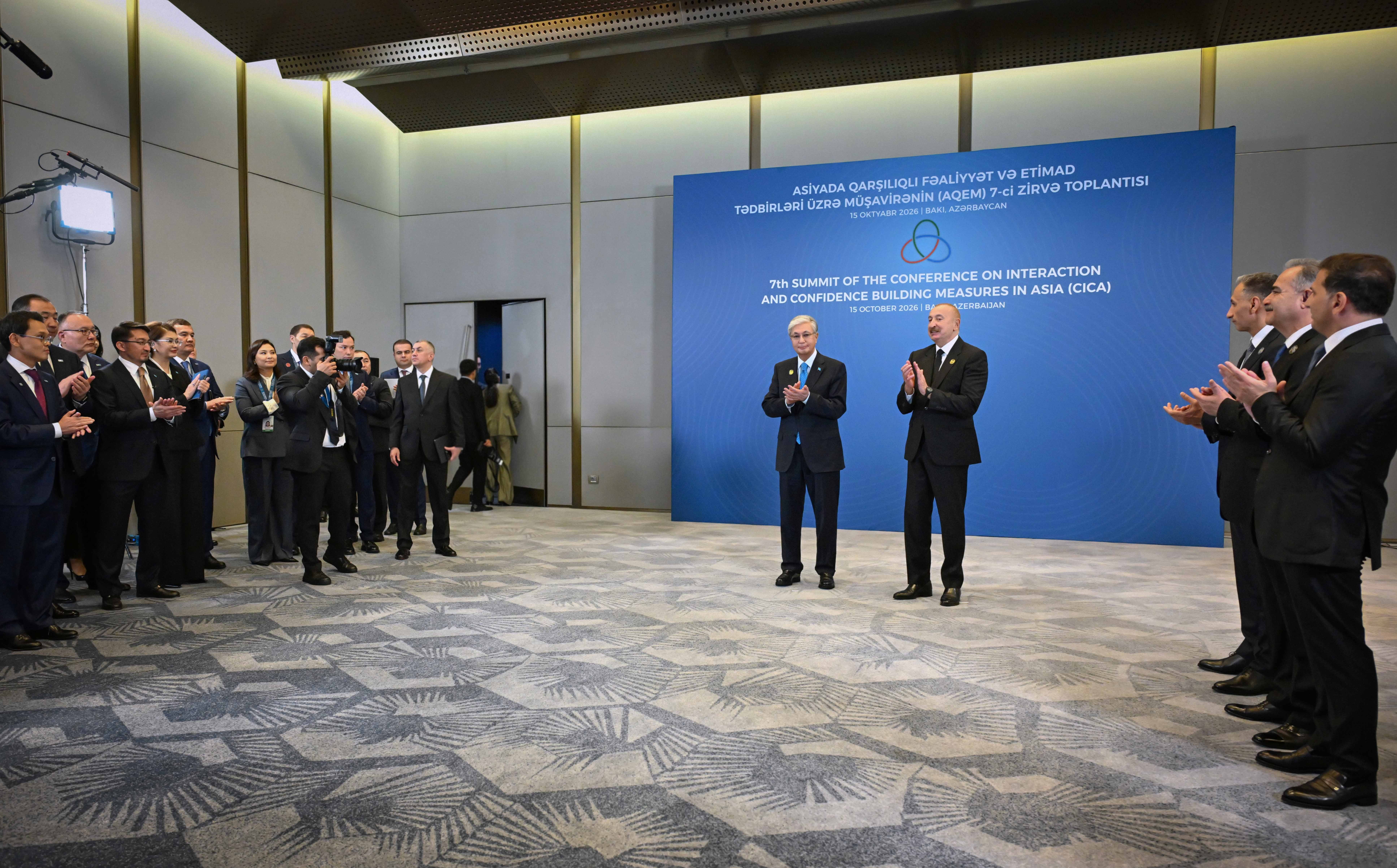
Aliyev said the communications line would be used by countries in Central Asia, the South Caucasus and surrounding regions. The Azerbaijan president described the line as the beginning of a global initiative.
Agreement on infrastructure for the Middle Corridor
At the ceremony attended by Tokayev and Aliyev, the two countries also signed an intergovernmental agreement on developing the international transport route across the Caspian, also known as the Middle Corridor.
The agreement aims to make freight transport between Asia and Europe more efficient, modernize transport infrastructure and remove existing restrictions along the route. Planned measures include increasing the capacity of railways and highways, developing port infrastructure, and strengthening maritime transport and dredging fleets in the Caspian.
The parties plan to integrate information systems for freight transport, introduce a single-window system, track cargo along the route and mutually recognize electronic signatures. The agreement also includes facilitating administrative, border and customs procedures through advance information sharing and fewer inspections.
$1 billion trade target
The two leaders also held a bilateral meeting in Baku on the sidelines of the 7th Summit of the Conference on Interaction and Confidence-Building Measures in Asia. They discussed expanding trade and economic ties between Kazakhstan and Azerbaijan.

Tokayev and Aliyev reaffirmed their goal of increasing bilateral trade to $1 billion. They also discussed increasing shipments of Kazakhstan's energy resources through Azerbaijan, as well as joint projects in industry, energy, transport, logistics and agriculture.
Education, tourism, culture and interparliamentary cooperation were also discussed. The parties reiterated their interest in strengthening the strategic partnership and implementing previously concluded agreements.
Tokayev and Qatar's emir discuss energy projects
As part of the summit program, Tokayev also met with Qatar's Emir Sheikh Tamim bin Hamad Al Thani. The two leaders assessed ways to develop bilateral cooperation, increase investment and implement joint energy projects.
They exchanged views on international and regional developments. The situation in the Middle East was also among the topics discussed at the meeting.