- BIST10011,131-3.02%
- USD50.47+0.05%
- EUR55.46+0.20%
- GOLD3,539.00-3.98%
- INTEREST36.00%-1.00
- BITCOIN59,042-4.62%
- November 21, 202616°
- BIST10011,131-3.02%
- USD50.47+0.05%
- EUR55.46+0.20%
- GOLD3,539.00-3.98%
- INTEREST36.00%-1.00
- BITCOIN59,042-4.62%
- November 21, 202616°
Chinese Academy of Sciences scientists to gain access to MBIR reactor
The leader of the MBIR International Research Center consortium and the Institute of Modern Physics of the Chinese Academy of Sciences in Lanzhou have signed a cooperation agreement. The parties will explore using the reactor to study reactor-accelerator systems, materials science and neutron science.


Chinese physicists will be able to take part in research at the MBIR multipurpose fast research reactor, which is under construction in Dimitrovgrad, Ulyanovsk Region. The cooperation agreement was signed by Leader of the Consortium “International Research Center Based on the MBIR Reactor” LLC, part of the Rosatom group, and the Institute of Modern Physics of the Chinese Academy of Sciences (IMP CAS), the industry portal Atom Media reported.
The institute, based in Lanzhou, specializes in heavy-ion physics and accelerator technologies. Under the agreement, its representatives will participate in the international center’s scientific activities, including meetings of the Advisory Council and its specialized committees. The parties will also work out the terms for using MBIR to study reactor-accelerator (ADS) systems, materials science and neutron experiments, as well as the procedure for the Chinese institute to join the consortium.
“MBIR complements our accelerator facilities with neutron capabilities. The areas set out in the agreement—ADS systems and neutron science—require precisely these kinds of experiments,” said IMP CAS Deputy Director Professor Yuan He. Vasily Konstantinov, CEO of Leader of the Consortium, expressed confidence that the expertise of his Chinese colleagues would be in demand when the reactor’s research program is developed.
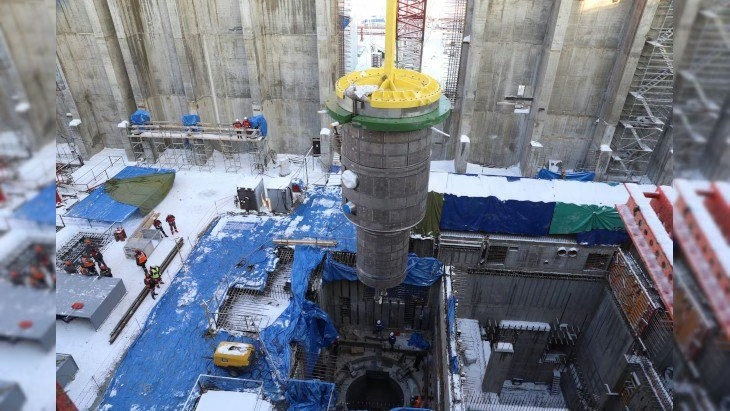
The most powerful research reactor
MBIR is a fourth-generation fast-neutron research reactor with a sodium coolant and a thermal capacity of 150 MW. It is being built at the site of the Research Institute of Atomic Reactors (RIAR) as part of the national New Nuclear and Energy Technologies project. Commissioning is scheduled for 2028, after which MBIR is expected to become the world’s most powerful operating research reactor.
In early November, Rosatom chief Alexey Likhachev inspected the site. “There is nothing comparable in the world, and nothing planned, in terms of the breadth of technologies and the quality of research programs. That is why MBIR is also an international consortium: many countries are showing interest in the project,” he said. Earlier, in June, the Institute of Plasma Physics of the Chinese Academy of Sciences reached an agreement to conduct materials science experiments for fusion energy at MBIR, while in November the Vietnam Atomic Energy Institute (Vinatom) signed a memorandum of understanding with the consortium.
Photo: Kommersant, open sources (archive). Sources: Atom Media, Mail.ru, Kommersant, SAMARAONLINE24, Ulpressa.
Stay Updated with RuskiGazeta
Subscribe to be informed about special news, developments and announcements. We will keep you informed.
By signing up, you agree to our Privacy Policy