U.S. President Donald Trump responded to the Republican Party’s crushing defeat in the midterm elections with a post containing no words: on his social network Truth Social, he shared an image of a red cap bearing the word “VETO.” The post signaled how he intends to respond to legislation that Congress, now under Democratic control, will pass.
According to projections by CNN, CBS, ABC and NBC News, Democrats won majorities in both chambers. The new Congress will begin work in January, and Trump will spend the final two years of his presidential term dealing with an opposition-controlled legislature.

“I thought they would do better”
On election day, Trump told CBS News that if Democrats won, he would use his veto power and his “enormous powers.” But on election night, when he called Fox News from the White House, he was noticeably more restrained. Asked about the performance of Republican candidates, the president replied: “I’m a little surprised. I thought they would do better.”
In an interview with The New York Times, Trump said he was “absolutely ready to accept these results” and added: “We will work with the Democrats.” He attributed the defeat to his own absence from the elections and said he did not regret supporting Darlene Graham in South Carolina and Texas Attorney General Ken Paxton—both of whom lost.
The scale of the defeat
According to MS NOW, Democrats wrested at least seven Senate seats from Republicans, who had held a 53–47 majority, and won at least 245 of the 435 seats in the House of Representatives. In Texas, Democrat James Talarico defeated Ken Paxton in the race for a Senate seat, ending the Democrats’ losing streak in statewide elections that had lasted since 1994, while Gina Hinojosa defeated Governor Greg Abbott. In Maine, Republican Senator Susan Collins lost to Troy Jackson; in Ohio, Sherrod Brown defeated Senator Jon Husted; and in Kansas, Adam Hamilton defeated Senator Roger Marshall.
During the night, Trump suggested on Fox News that the counting of votes mattered more, in his view, than the candidates themselves, although he cited no specific irregularities: “The people who count the votes are much more important than the candidates.”
A few hours later, the president lashed out at the same network he had called. On Truth Social, he objected to Fox News inviting former New York Mayor Bill de Blasio and wrote that the network was “responsible for these losses” because it continually gave airtime to the Democratic opposition. Trump also promised to become a “political commentator” and analyze why some candidates won while others lost.
“How did we get here?”
CNN reported, citing more than a dozen aides, advisers and Republican political strategists, that Trump had privately asked a close ally at a rally in October: “How did we get here?” People around the president identified the war with Iran, launched in February, as the main cause of the setback: it disrupted months of election preparation and drove up fuel prices. Republicans also criticized the administration’s neglect of the cost-of-living issue, weak candidates and late campaign spending. “Honestly, only one person is to blame,” one strategist concluded.
Even on the night of the defeat, Trump mentioned Greenland, one of the main foreign-policy goals of his second term: “Greenland is three times bigger than Texas, and we got it.”
A blue wave across the map
An analysis by The New York Times at the district level showed how broad the shift was. In districts where the count was nearly complete, results had shifted toward Democrats by an average of 16 percentage points, compared with a five-point shift toward Republicans in 2024. Even in Tennessee and Kentucky, where Democrats lost, the shift in their favor reached 18 points.
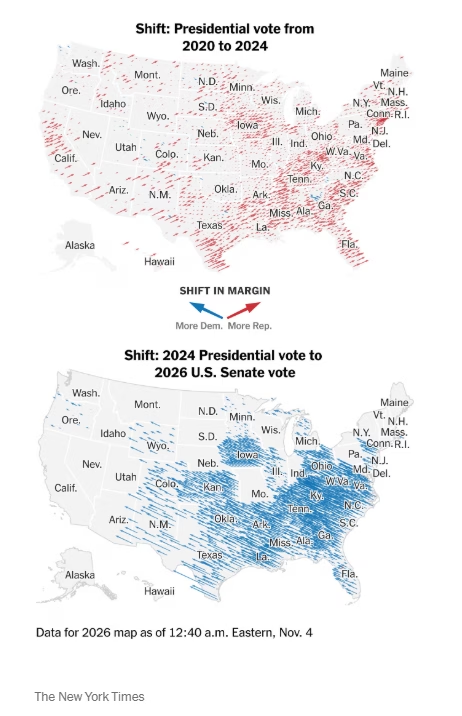
According to an SSRS exit poll conducted for a consortium of U.S. media outlets, 70% of voters want Congress to exercise stronger oversight of the president, while half of those surveyed viewed the elections as an opportunity to express their dissatisfaction with him. By winning the House of Representatives, Democrats will be able to block legislation and launch investigations into the war with Iran, immigration policy and corruption allegations, while control of the Senate will allow them to slow the confirmation of judges and senior officials. Elon Musk, who headed the DOGE agency in 2025, also reacted to the election results: “Data centers in space are looking pretty attractive right now.”
Video: Fox News / social media. Images: Truth Social, The New York Times