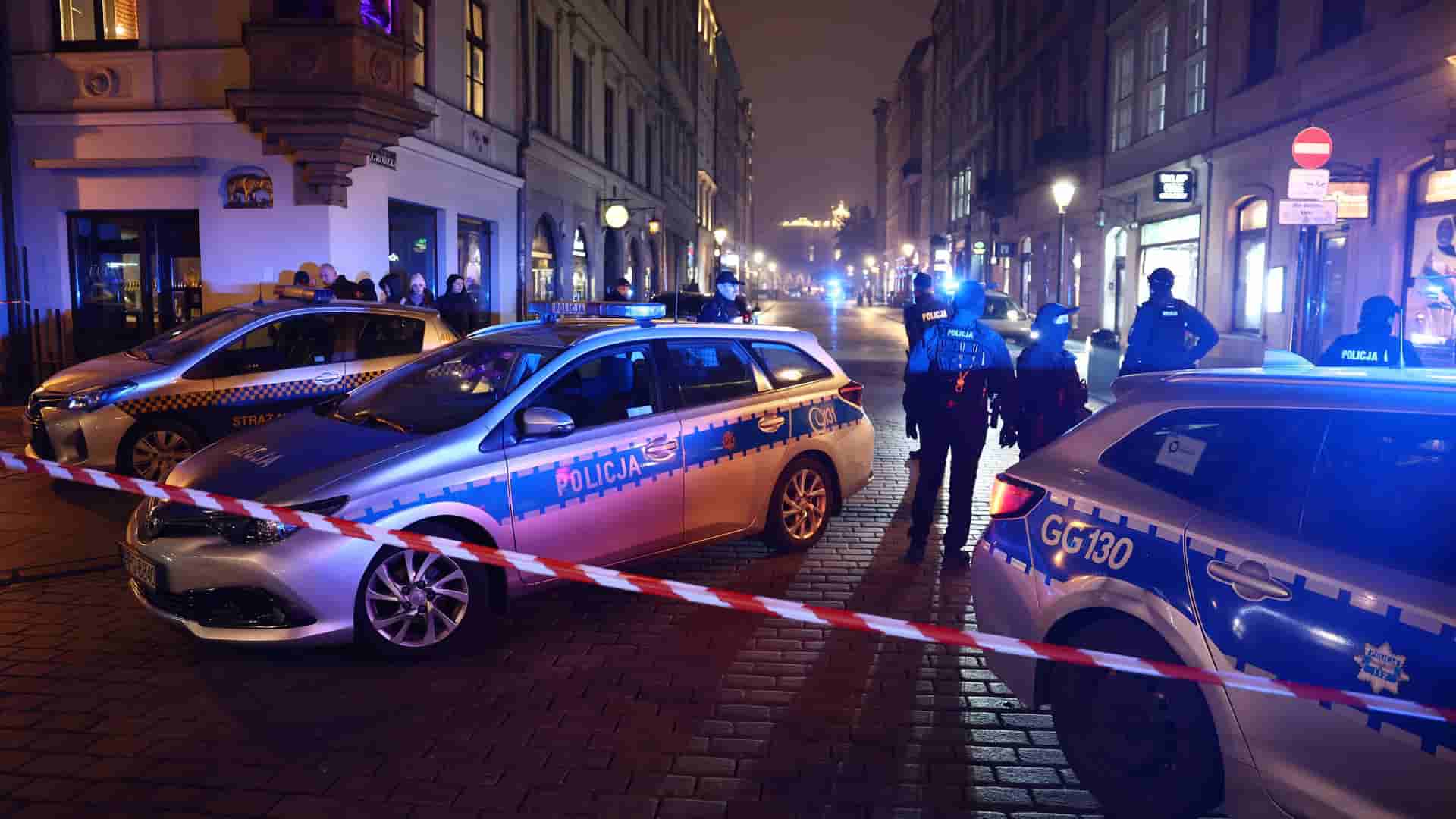
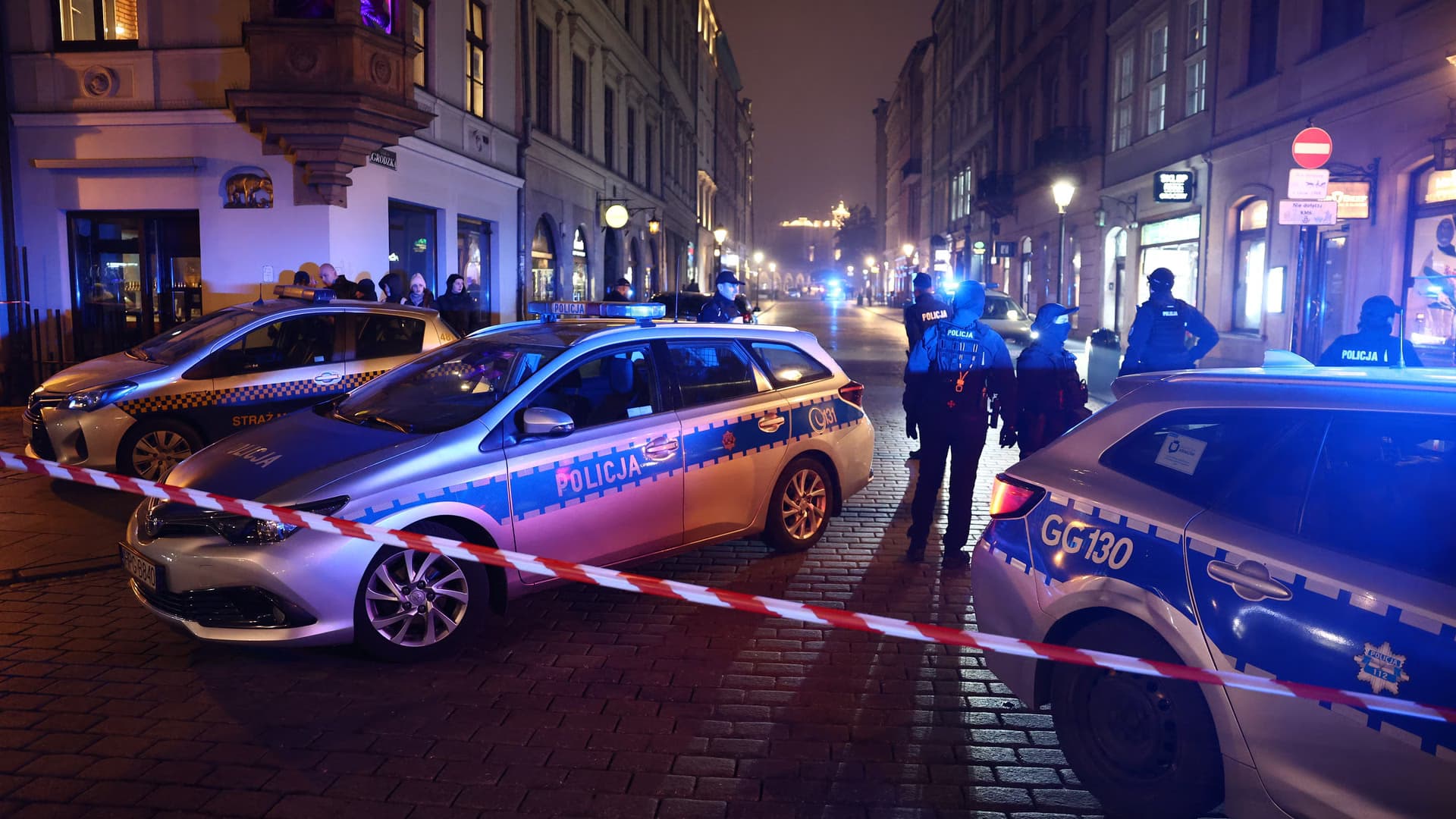
The death toll from Saturday’s shooting on Kraków’s Main Market Square stands at six: four women and two men. Fifteen people were injured, including two police officers; 16 people, including the shooter, were taken to hospitals. On Sunday morning, Andrzej Fijołek, a spokesman for the National Police Headquarters, said the death toll had not changed and the condition of the injured had not deteriorated. At around 3 p.m. local time (5 p.m. Moscow time), a man driving a black Subaru entered the square, which was closed to vehicles, from Sławkowska Street and opened fire on passersby before driving toward Wawel. He was stopped at the intersection of Dietla and Stradomska streets, where he exchanged fire with police, was wounded and arrested.
Foreign nationals were among those affected. Poland’s Interior Ministry said citizens of Austria, Germany, Portugal, Russia and the United Kingdom were injured. Chief Police Commander Marek Boroń said that three Polish women and a British citizen were among the four victims who had been identified.
What is known about the shooter
Police said the attacker was a 24-year-old Polish citizen born in 2002 from Ostrowiec Świętokrzyski who had no previous convictions and held a gun permit. His name was not officially released; Polish media, which under local practice identify suspects only by the first letter of their surname, referred to him as Michał O. Fijołek said on TVN24 that the man fired a civilian version of an AR-15 carbine and added on Sunday that his vehicle probably contained five firearms. RMF24 radio, citing the PAP news agency, reported that the permit had been issued for sporting purposes and covered both a carbine and a handgun.
Interior Minister Marcin Kierwiński said one line of the investigation was that the weapons may have been taken from the family home, where the attacker’s father also held a permit. The minister said the man had fired an automatic weapon. Prosecutors and ballistic experts are determining the exact type of weapon, its mechanism and its origin. Poland’s Law on Weapons and Ammunition does not allow civilians to receive permits for automatic weapons, while sporting permits apply only to self-loading firearms.
Kierwiński also said that “an initial analysis points to ultranationalist views,” but stressed that this would still be verified. Defense Minister Władysław Kosiniak-Kamysz denied reports circulating on social media that the shooter was a soldier: “The man was not and is not a soldier of the Polish Armed Forces and has never had anything to do with the army.” He was nevertheless wearing camouflage, a helmet and a bulletproof vest.
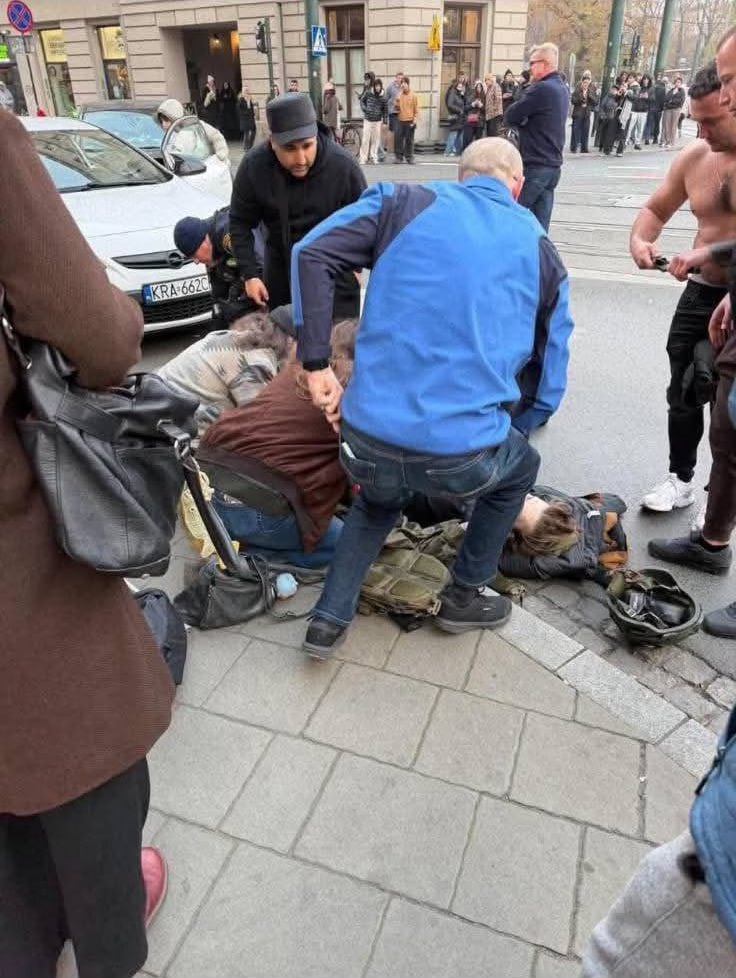
In a photograph circulated on social media, passersby and police officers restrain the attacker after the exchange of fire at the intersection of Dietla and Stradomska streets. Katarzyna Cisło, a spokeswoman for the Lesser Poland police, said the man continued shooting at police even after he had fallen. Krzysztof Klęczar, governor of the Lesser Poland Voivodeship, said on Sunday that the shooter was in critical condition, while the two injured officers had survived the night and were feeling better than the previous evening, although their condition remained serious.
Parents’ and sister’s bodies found
Late Saturday evening, Tusk said the bodies of two women and a man had been found in the attacker’s apartment in Ostrowiec Świętokrzyski, about 150 kilometers northeast of Kraków. “These are the next acts of this tragedy,” the prime minister said. On Sunday morning, Fijołek уточнил, что погибли 53-летний отец, 52-летняя мать и 20-летняя сестра стрелка: на телах обнаружены огнестрельные ранения, от которых они, вероятнее всего, и скончались. Эти трое не входят в число шести погибших в Кракове, обстоятельства их смерти устанавливает следствие. Представитель прокуратуры Томаш Ващук заявил, что квалификация обвинений пока не определена, а следователи проверяют, не помогал ли кто-нибудь нападавшему.
Dispute over police and the Constitutional Tribunal
Prime Minister Donald Tusk called the shooting a terrorist attack (zamach in Polish), expressed condolences to the victims’ families and thanked the “heroic police officers who acted at risk to their lives.” “And a fervent appeal to politicians of all sides: do not exploit this tragedy. We will establish all the circumstances of this crime,” he wrote on X. The appeal came after Patrick Jaki, a European Parliament member from the Law and Justice party, said there were not enough police officers in the country’s busiest places because forces had been deployed to the Constitutional Tribunal building. Confederation lawmaker Konrad Berkowicz and Włodzimierz Skalik, head of the parliamentary group of the Confederation of the Polish Crown, expressed similar views, with Skalik blaming Tusk’s government.
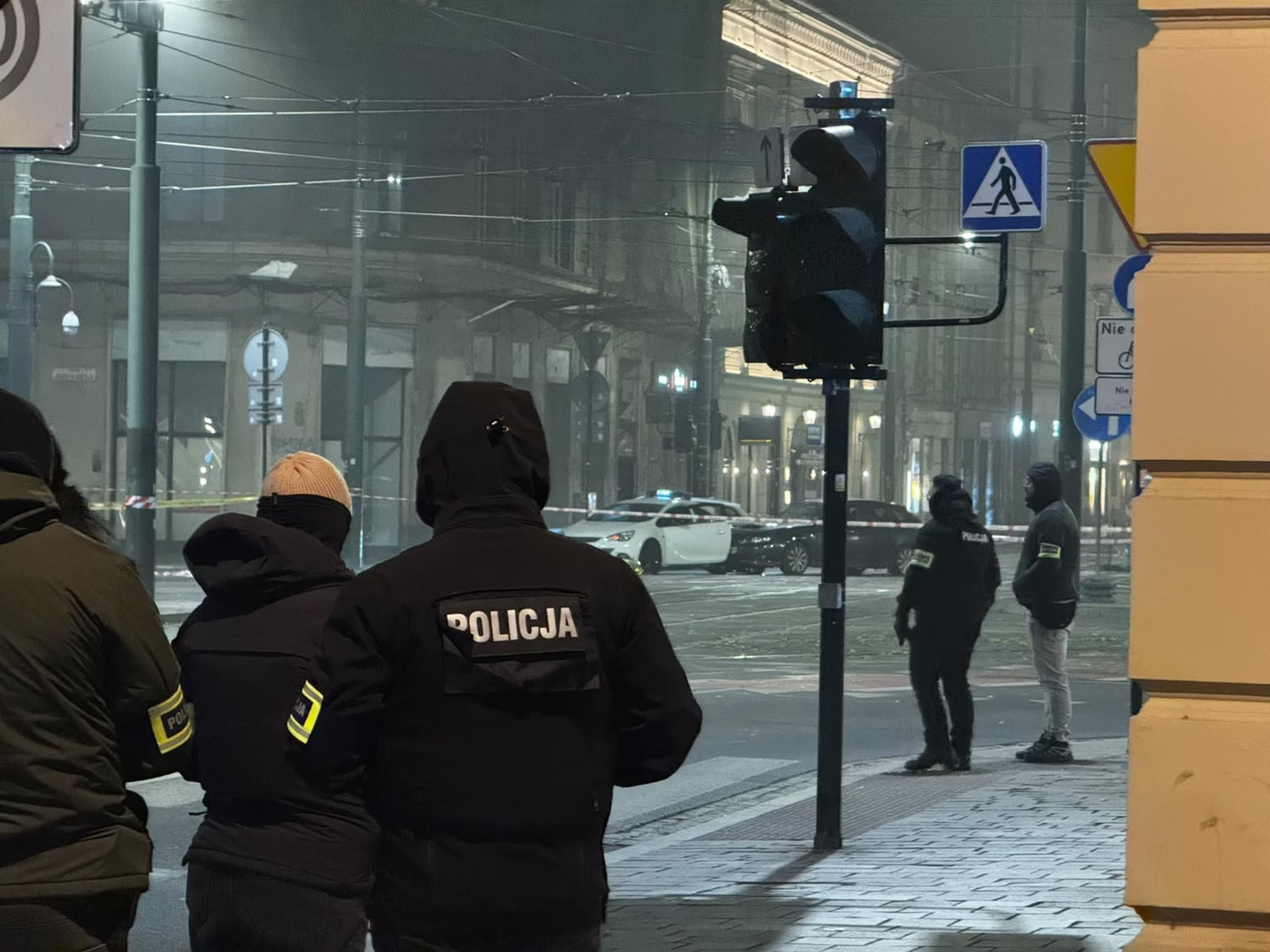
Lesser Poland police rejected accusations of a delayed response: “Police officers began intervening immediately. The first patrol took action just 23 seconds after the call.” Kierwiński said police opened fire on the attacker three minutes after the call and that their quick response prevented a far greater massacre. Tusk called the wounded officers, senior constables Jakub Kulik and Artur Morański, “true heroes” who probably saved many lives. During the night, police and Justice Minister Waldemar Żurek appealed for blood donations for Kulik, while Chief of the General Staff General Wiesław Kukuła urged military personnel to become donors.
After an emergency meeting with ministers and the command of the security services in Kraków, Tusk said: “Poland has never before experienced such brutal acts of terrorism. This brutal attack must be called exactly that.” Justice Minister and Prosecutor General Żurek said seven prosecutors had worked at the scene and that investigative activities were also carried out at the attacker’s home.
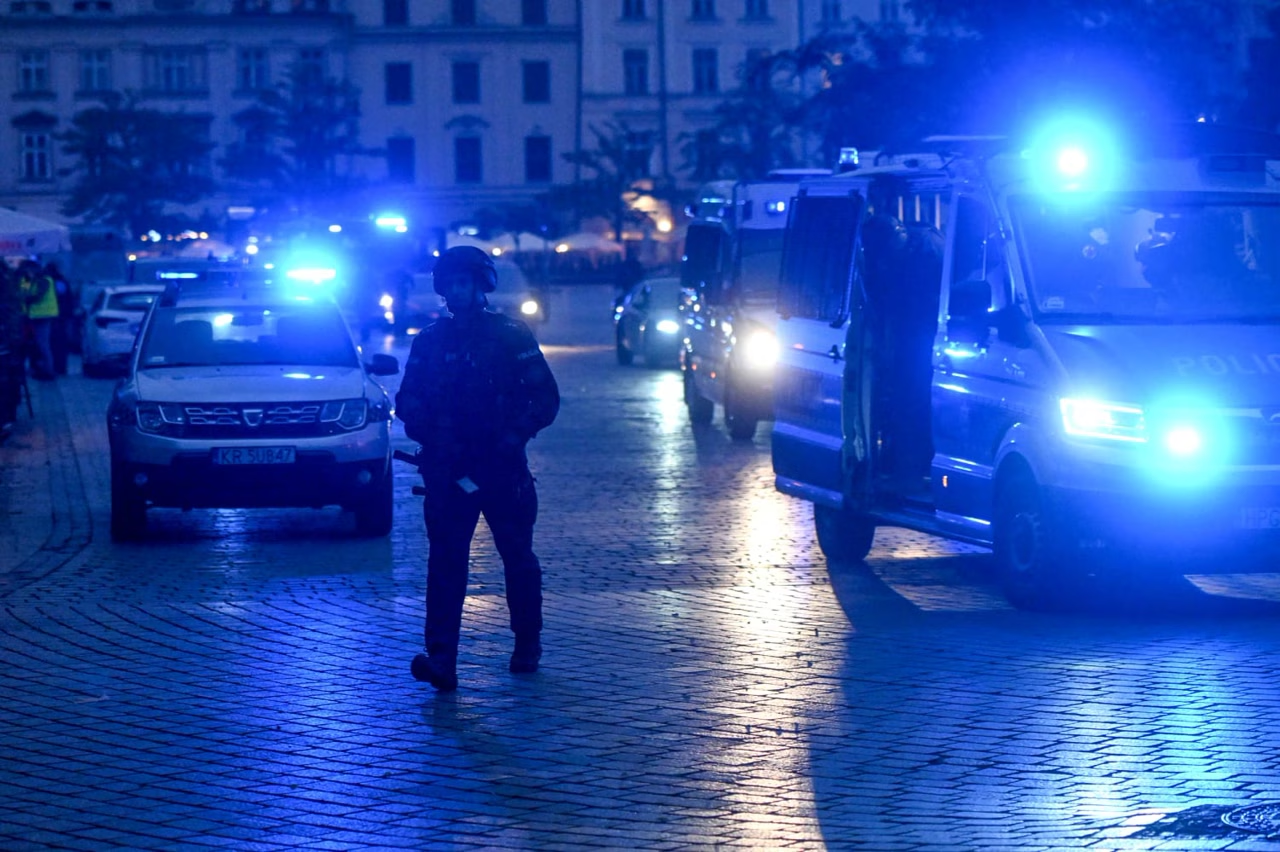
Security measures and mourning
President Karol Nawrocki signed an order declaring national mourning on November 8 and 9, while Kraków Mayor Łukasz Gibała declared mourning in the city until November 11. City events were canceled, and flags on buildings, trams and buses were flown at half-mast. Security measures were also strengthened in the capital: on the recommendation of police, concrete barriers were being installed on streets leading to Krakowskie Przedmieście, Warsaw Mayor Rafał Trzaskowski said.
In this video address, recorded on the evening of the attack, Gibała expressed condolences to the victims’ families, asked residents to avoid the Market area, rely only on official sources and refrain from spreading false information and videos from the scene of the tragedy. He thanked the city guard, which was the first to arrive, the police officers who “heroically and at risk to their lives” detained the attacker, and residents who opened their doors to people fleeing. “Violence will not change what kind of city we are: proud, welcoming and open. The Market will belong to all of us again,” the mayor said.
Part of the square reopened on Sunday morning, and the first candles appeared at the shooting sites. Mass shootings are rare in Poland. According to AP, in a country of about 37 million people, approximately 411,000 hold gun permits, and interest in firearms is growing. In mid-October, three attacks on schools occurred over four days in the Masovian Voivodeship, killing one person.
Photos: Jakub Porzycki/Reuters (cover), Getty Images, social media / Clash Report, LoveKraków. Video: Łukasz Gibała / X