Transport Minister declares Middle Corridor a strategic necessity for Europe after Russia-Ukraine war
Transport and Infrastructure Minister Abdulkadir Uraloğlu said disruptions in global supply chains and geopolitical developments have made the Middle Corridor a strategic necessity for the European Union. Uraloğlu emphasized that Turkey has become the EU's most important land gateway following the Russia-Ukraine war.
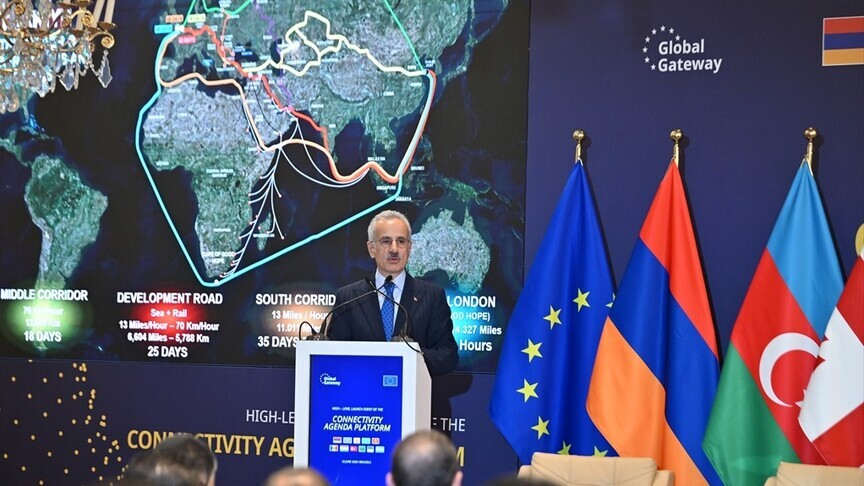
Transport and Infrastructure Minister Abdulkadir Uraloğlu spoke at a high-level connectivity event in Brussels. Uraloğlu stated that disruptions in global supply chains have highlighted the need for reliable, resilient, and high-capacity land corridors.
Turkey is Europe's gateway
The Minister emphasized that Turkey has become the European Union's most important land gateway following the Russia-Ukraine war. He said the Middle Corridor, also known as the East-West Corridor passing through the Caspian Sea, is an opportunity not only for Turkey but also for the interests of Central Asia and Europe.
Uraloğlu said, "The Middle Corridor is not a simple transport line connecting our regions; it is a strategic axis that strengthens economic security and the continuity of trade."
The corridor's future and global risks
He noted that the corridor's future lies in increasing its capacity, developing its digital infrastructure, facilitating border crossing procedures, and supporting it with integrated investment projects.
He added that the recent challenges in the Red Sea and developments around the Strait of Hormuz demonstrate the scale of risks threatening global supply chains. Uraloğlu underlined that keeping the Strait of Hormuz open without interruption to commercial maritime traffic is extremely important for the stability of global trade and supply chains.
Technical details of the Middle Corridor
The Middle Corridor connects China to European countries via Kazakhstan, the Caspian Sea, Azerbaijan, Georgia, and Turkey. This route reduces delivery time between Europe and Asia to 15 days and turns Turkey into a "trade backbone" directly connecting to 21 countries.
The total length of the corridor is stated as 4,256 kilometers via roads and railways, and 508 kilometers via sea.